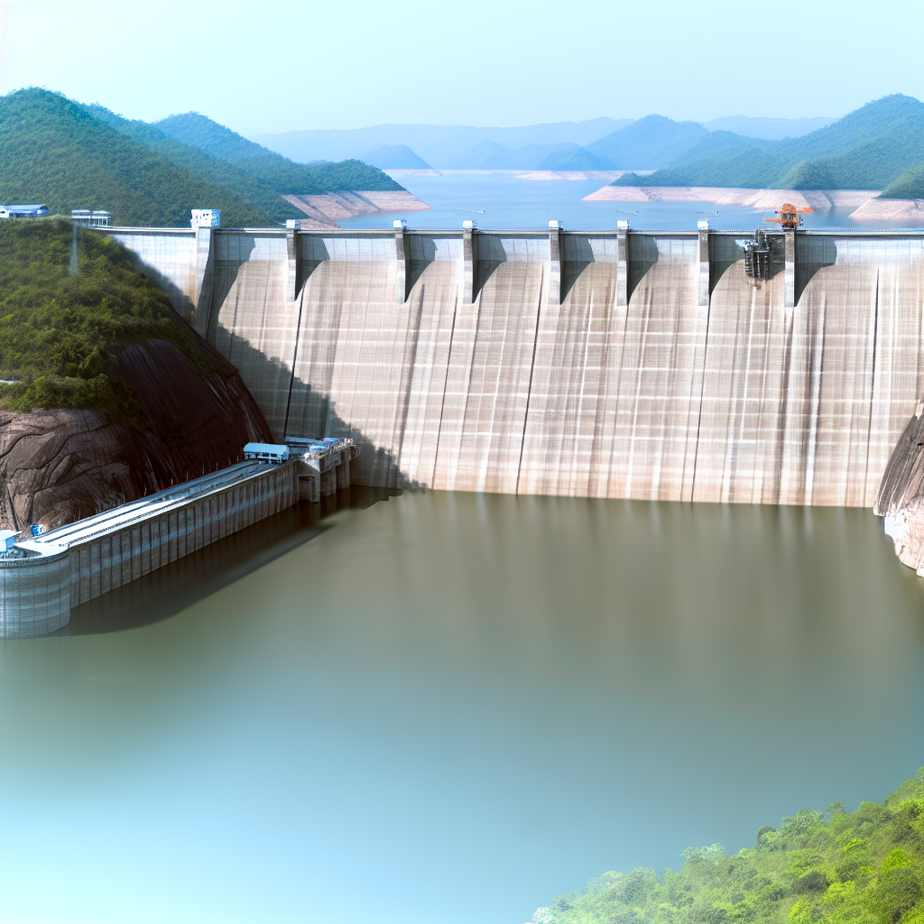
China has commenced the construction of what it claims to be the world’s largest hydropower project, an ambitious $170 billion endeavor expected to generate enough electricity annually to sustain Britain. This venture overshadows the existing Three Gorges Dam as the largest in the world. Premier Li Qiang’s announcement of the project led to a surge in Chinese construction and engineering equities.
For China, the mega-dam signifies clean energy, employment opportunities, and a push for economic growth. However, for countries downstream, it triggers concerns about water security, particularly with regards to the Yarlung Zangbo river, known as the Brahmaputra in India and Bangladesh, serving as a vital resource for millions.
The development plan includes constructing five dams along a 50-km stretch where the river cascades 2,000 meters off the Tibetan Plateau. Although initial power generation is anticipated in the early-to-mid 2030s, beyond the timeline and the financial commitment, China has divulged limited details about the project’s execution.
The scarcity of information intensifies apprehensions about water security among neighboring nations like India and Bangladesh, which heavily depend on the Brahmaputra for irrigation, hydropower, and potable water. Concerns have been raised by the Chief Minister of Arunachal Pradesh—bordering China—who forecasts potential water scarcity in the Indian state, emphasizing the possibility of flooding in downstream territories.
Besides water supply concerns, the decrease in sediment transport downstream is pertinent. According to Michael Steckler of Columbia University, insufficient sediment flow could impact agriculture on the floodplains downstream, hindering the crucial nutrient supplies for farming.
The historical context adds weight to the concerns. The troubled past between India and China, marked by a border conflict in the 1960s, coupled with Beijing’s lack of transparency, fuels speculations that the dam could be exploited for political leverage in the future. The lack of clarity from Beijing raises suspicions of potential water disputes and power play in the region, echoing sentiments from experts experienced in the India-China water relations.
The uncertainty surrounding the impact of the dam on downstream water levels may have been exaggerated, with experts emphasizing that the primary water source of the Brahmaputra is monsoon rainfall rather than contributions from China. Plans for a ‘run of the river’ hydropower project by China suggest uninterrupted water flow along the regular Brahmaputra course. India, on the other hand, has put forth proposals for dams on the Siang river, aimed at solidifying its water claims and precluding any future attempts by China to manipulate water resources.