
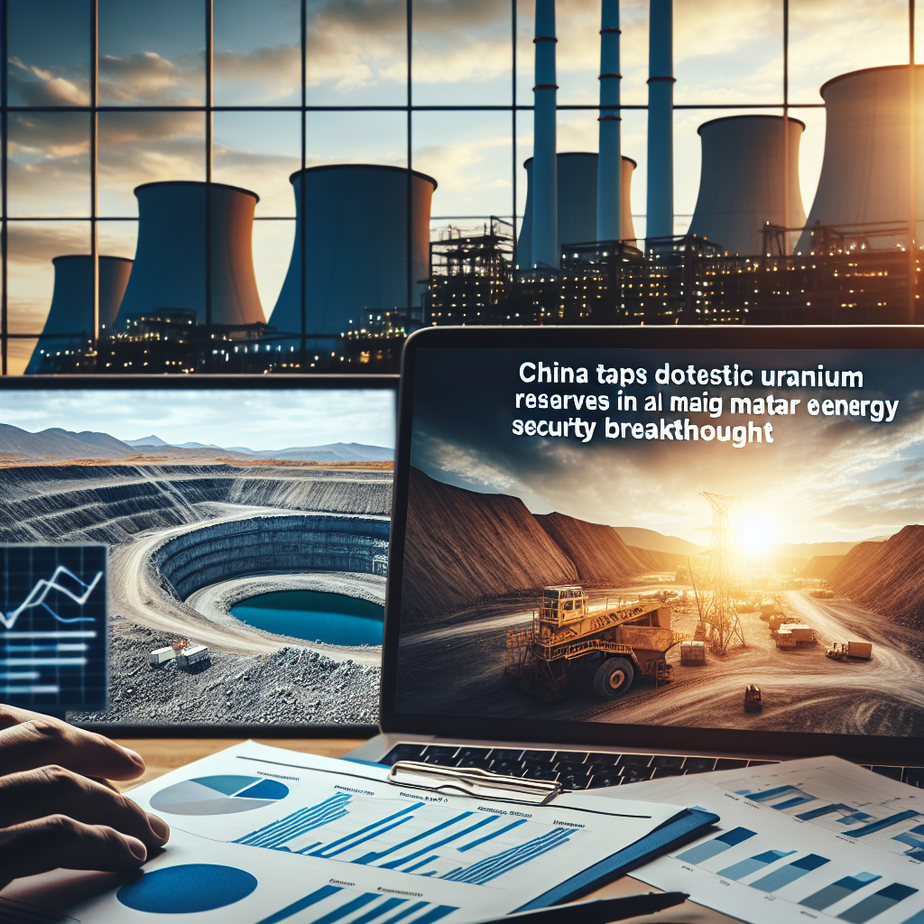
China has celebrated a major milestone in its nuclear energy ambitions with the production of its first barrel of natural uranium from its largest ever domestic uranium development—the ‘National No 1 Uranium’ demonstration project. The announcement, made by the China National Nuclear Corporation (CNNC), marks a strategic pivot in reinforcing national energy security through bolstering uranium self-sufficiency.
The initiative, launched in 2023, is located in the Ordos basin in northern Inner Mongolia, a region identified for housing some of the most abundant uranium reserves in the country. This area now assumes a pivotal role in reshaping China’s uranium mining landscape, moving production away from the traditional central province of Jiangxi. According to state-run media outlet Xinhua, the milestone reflects a mining model that is “green, safe, intelligent and efficient.”
Previously, China’s uranium extraction was concentrated around granite and volcanic formations near the city of Lean in Jiangxi province. However, the past twenty years have seen significant discoveries of sandstone-type deposits in China’s northern territories. These deposits, particularly prevalent in Inner Mongolia, were once considered economically unviable due to limited extraction technology. This perception has shifted with the advent of in situ leaching—an advanced method that now allows the tapping of these previously overlooked resources.
The South China Morning Post reported that in situ leaching has turned around the potential of so-called ‘dull mines,’ once disregarded in the uranium sector. Yuan Xu, chairman of China National Uranium Corporation—a CNNC subsidiary—hailed this project as marking a new epoch in domestic uranium mining. He emphasized the integration of modern technologies including remote-controlled equipment to minimize worker exposure, intelligent data platforms for process optimization, and stringent environmental safeguards.
According to Chinese media outlets, the project was completed in record time—just one year from groundbreaking to production. In a testament to China’s growing uranium exploration efforts, the year 2023 alone saw ten major uranium finds totaling over 2.8 million tonnes of resource estimates. Of these, six were located in Inner Mongolia, underlining the strategic importance of the region. Unlike Jiangxi’s granite deposits, which require conventional hard-rock mining, the cleaner sandstone deposits of the north are now extractable using modern, less invasive techniques.
Experts at the China National Uranium Corporation likened in situ leaching to an intravenous drip. The process injects a solution into underground ore via wells, dissolving uranium where it lies; the uranium-rich fluid is then pumped to the surface for refinement. Unlike traditional acid or alkaline methods, which pose considerable environmental risks, this technique employs a carbon dioxide and oxygen solution that mitigates harm. The process avoids the need for tunneling, eliminates surface disruption, and results in no radioactive emissions, underscoring its environmental advantages.
China continues to cement its global leadership in nuclear energy capacity. According to the China Energy Research Society, the country tops global rankings in total nuclear power generation capacity when counting active, under-construction, and approved reactors. The recent development of the ‘National No 1 Uranium’ site is expected to support this growth by providing a sustainable and secure domestic uranium supply, contributing meaningfully to the nation’s green energy transition goals.