
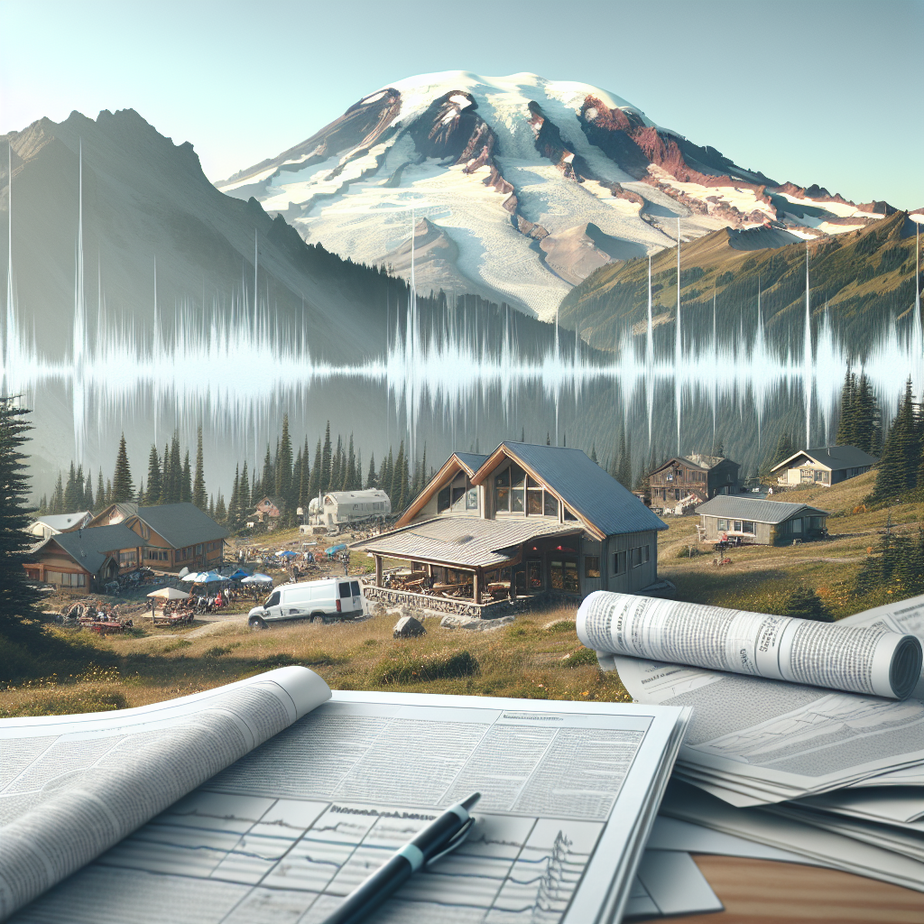
Mount Rainier, Washington’s highest peak, is currently undergoing a significant swarm of earthquakes, marking the most intense seismic activity the volcano has experienced since 2009. Seismologists from the U.S. Geological Survey (USGS) report that the mountain has been struck by hundreds of small tremors in recent days, raising concerns and prompting thorough observation.
The seismic sequence began earlier this week, centered on a series of small but rapid-fire earthquakes in the vicinity of the volcano. Wes Thelen, a seismologist based at the Cascades Volcano Observatory, explained to FOX 13 Seattle that the swarm started with a sudden spike in activity. “We had an increase in activity in seismic activity up to about 26 events an hour, which is a pretty good event rate for a quiet volcano,” Thelen stated. “Since then, it’s tailed off.”
Despite the current drop in activity, experts caution that the situation may not be over yet. Thelen emphasized that the current pause in tremors may be temporary and more quakes may follow. “We don’t necessarily have a crystal ball to understand what is happening under there,” he said, acknowledging the complexity of the subsurface processes driving the swarm.
On Wednesday morning, equipment detected a magnitude 2.3 earthquake among the ongoing sequence of tremors, the largest recorded in the current swarm. According to Thelen, this particular cluster of earthquakes is thought to be caused by the movement of hot fluids navigating through existing faults beneath the volcano. This mechanism is considered relatively typical for Mount Rainier.
“These things at Mount Rainier we have seen before, and we expect to see them again in the future,” Thelen noted. While such seismic activity can be unsettling, he reassured that it’s not entirely out of the ordinary. Mount Rainier, although a potentially dangerous volcano, has remained mostly quiet on a long-term scale.
The last eruption of Mount Rainier occurred approximately 1,000 years ago. However, Thelen pointed out that in the broader context of volcanic history, the mountain hasn’t been particularly active over the past 10,000 years. “Even though it was a thousand years ago, Rainier is not overall in a particularly active state over, let’s say, 10,000 years,” he said.
In 2017, scientists also recorded a similar, though smaller, sequence of tremors at Mount Rainier, categorized as a “swarm” by USGS. Seismologists continue to monitor the current situation closely to ensure prompt detections of any changes that may indicate increased risk.